Choosing a hiking tent isn’t as simple as picking the lightest one you can afford, and the most expensive tent on the shelf isn’t automatically the right one for you. It has to keep you dry when the weather turns, give you a comfortable place to rest after a long day on the trail, and go up and down without a fight when you’re tired, cold, and running low on daylight. Get it right and you’ll barely think about your tent. It pitches without a fuss, keeps the weather where it belongs, and packs away the next morning without a wrestle.
So what makes a tent right for you? It comes down to how often you get out, where you’re headed, and how much you’re happy to carry. A first-timer doing a couple of overnighters a year needs something very different from a seasoned trekker tackling the Overland Track in shoulder season.
We’ve split this guide into four sections. It starts with first tents and budget-friendly picks, moves through mid-range all-rounders, and finishes with high-performance shelters built for serious conditions. For the minimalists, there’s also a round-up of tarps and flies at the end.
Jump straight to
Before you buy: what to look for
Weight and packed size. Every gram counts once it’s on your back, but lighter tents usually trade away some durability, space, or budget. For most hikers, a 2-person tent around 2-2.5kg is a comfortable middle ground. Serious multi-day trekkers often aim lower.
Price. A higher price usually buys higher performance, meaning lighter weight and a smaller packed size, rather than more durability. A top-of-the-range superlight tent uses technical fabrics engineered to shave off every possible gram. What you’re not getting is a floor that shrugs off sharp, stony ground the way a mid-range tent will, because that mid-range tent uses thicker, heavier materials. It comes down to what matters most to you. A lightweight tent is kinder to your shoulders on a long day, but it asks for more care when you’re choosing a site and packing it away. A heavier tent is easier on the wallet and more forgiving in the field and in storage, but you’ll feel those extra grams on the climb.
Capacity. Tent capacities assume snug sleeping. Many solo hikers go for a 2-person tent for room to store gear inside, and couples often find a 2-person tent cosy but workable. That said, modern pole configurations mean plenty of 1-person tents no longer feel claustrophobic. Sea to Summit’s 1P tents are a good example.
Seasonality. 3-season tents cover most Australian hiking, from spring through autumn, and plenty of winter trips in milder regions. 4-season or storm-rated tents are for alpine areas, exposed ridgelines, and places where the weather can turn fast. Some 3-season tents will handle 4-season conditions if you account for their shortcomings, such as extra mesh letting cold air through. A 4-season tent works in 3-season conditions too, though you’ll likely need every vent and door open to stay comfortable.
Freestanding vs non-freestanding. A freestanding tent holds its shape on its poles alone, which makes it easy to pitch on hard ground or tent platforms and simple to reposition. Non-freestanding and trekking-pole tents rely on pegs and guy lines for structure. They’re often lighter, but need good ground and a bit more pitching know-how.
Single wall vs double wall. Most hiking tents are double wall, with an inner tent and a separate fly. That gives better condensation control and versatility. Single wall tents are lighter, but condensation is harder to manage.
Weather protection. Waterhead ratings tell you how much water pressure a fabric withstands before leaking, but they’re only part of the picture. Seam taping, fly coverage, pole strength, and plenty of guy points all matter just as much in a real storm. Don’t get too caught up in the numbers unless you’re heading somewhere extreme, since 1000mm is generally considered waterproof for the average hiker.
Liveability. Two doors mean no climbing over your hiking partner at 2am, and two vestibules give each of you somewhere dry for your boots and pack. Head height, wall shape, and internal pockets make a big difference on a rainy afternoon stuck inside.
Setup style. Inner-first tents are usually quick and intuitive to pitch. Fly-first and all-in-one designs keep the inner dry when you’re pitching in the rain, which really only matters if you hike somewhere particularly wet.

Entry-level value hiking tents
Whether you’re heading out for your first overnighter or testing the waters before committing to premium gear, these tents deliver where it counts. They’re reliable, easy to pitch, and ready for the trail from day one.
Exceptional value: a lot of tent for the money – Companion Pro Hiker

Don’t let its entry-level position fool you. The Pro Hiker has been one of our most popular hiking tents for years, and it’s easy to see why. Twin doors and vestibules give you proper access and gear storage. Alloy poles keep the structure strong without adding bulk, and roof vents help keep condensation in check overnight.
Inside, organiser pockets and a gear loft keep your torch, phone, and snacks off the floor. A compression bag keeps the packed size manageable. It’s a well-rounded tent boasting durability and performance well above its weight class.
Key specs: 2.7kg | Simple cross pole dome frame | 3000mm waterhead fly | 8.5mm alloy poles | 100+ 4-5 star reviews
Worth knowing: At 2.7kg for the 2-person, it’s on the heavier side for longer multi-day hikes.
Best for: New and occasional hikers, scouts, and motorcycle tourers who want a proven all-rounder.
Best budget: for occasional use – OZtrail Nomad 2

The Nomad keeps things simple, and that’s its strength. The design is minimal and light on the shoulders. Short-section poles pack down neatly, and a generous door makes getting in and out easy. A full mesh inner facilitates ventilation and the tub-style floor helps keep ground moisture at bay.
Not everyone needs to invest in the best. With dependable construction and a very friendly price tag, the Nomad range is ideal for stashing in the garage, ready for the occasional overnighter.
Key specs (2P): 1.30kg | Dual entrance | Low wind resistant design | fibreglass poles
Also available in a single pole 1P version
Worth knowing: The Nomad range isn’t freestanding and needs plenty of peg points to stay upright. It also doesn’t carry a formal waterhead rating. Fibreglass poles are heavier and less durable than alloy.
Best for: Occasional hikers, fair-weather overnighters, and anyone who wants a very affordable & dependable backup tent.
Best first hiking tent – BlackWolf Cicada

Whether you’re buying your own first hiking tent or kitting out a young scout or budding adventurer, the Cicada is a brilliant place to start. It looks the part and comes loaded with features, and it’s built well enough to handle plenty of trips as their hiking confidence grows.
Two D-shaped doors each with a roomy vestibule, a generous 110cm of head height means two people can share without bumping elbows. Fully taped seams and a UV-treated fly keep the weather out, and reflective guy ropes help with after-dark setups, which is handy for first-timers still finding their feet. A fully mesh inner and roof vents keep air flowing, making it a great match for humid coastal hikes and summer trips.
Key specs (2P): 2.62 Kg | 5000mm waterhead fly| Full mesh inner | Classic dome configuration | 2 doors, 2 vestibules | Ground sheet included
Worth knowing: The full mesh inner lets wind through more readily, great for condensation management but less suited to very cold winter trips.
Best for: First-time hikers, scouts, and young adventurers, or anyone gifting a first hiking tent.
Mid-range all-round hiking tents
This is the sweet spot for regular hikers. These tents step up in weight, weather protection, and features without stepping into premium territory, so they’re built to handle weekend after weekend on the track.
Best all-rounder – Explore Planet Earth Spartan 2

The Spartan gets the balance right. It’s light enough to carry comfortably and roomy enough for two. It’s also tough enough to shrug off a proper downpour. A colour-coded frame with speed clips makes pitching quick & creates loads of headroom, while two doors and vestibules give you easy entry and exit from either side.
The fly carries an impressive waterproof rating for a tent in this category, while a full nylon inner pairs with roof vents for exceptional climate control in all environments. Accessory pockets and a roof loft keep your gear organised.
Key specs (2P): 2.4kg | 4000mm fly, 5000mm floor | alloy poles | 46 x 14 x 14cm packed | 0.6 x 2.15m vestibule
Available in 1P and 3P versions.
Worth knowing: The Spartan has a full nylon inner and two vents making it suitable for colder weather adventures.
Best for: Regular hikers, solo trekkers who like space, and couples who want one tent for nearly every trip.
Technical and affordable – Naturehike Cloud Up 3

Naturehike has built a strong following among hikers who want features usually found on premium tents without the premium price tag. Across the range, you’ll find high-grade alloy poles, lightweight ripstop fabrics, and thoughtful ventilation.
The Cloud Up 3P is a roomy & lightweight hiking tent. A Y-shaped pole system makes it quick to pitch, and it combines 20D nylon, 4000mm waterproofing, and 7001 alloy poles. It even comes with a footprint included.
Key specs (Cloud Up 1P): 2.29 Kg | 20D nylon waterhead fly | 7001 alloy poles | footprint included
Worth knowing: The Cloud Up range features one entrance and vestibule improving perfomrance in bad weather but limiting livability for two people.
Also available in 1P and 2P versions >>
Best for: Weight-conscious hikers who want technical features without stepping up to premium gear.
Durable and roomy – BlackWolf Grasshopper

The Grasshopper’s pole layout creates a dome with near-upright sidewalls, which frees up noticeably more internal space. The result is a tent that feels bigger than its footprint. There’s room to sit up, sort your gear, and wait out a shower without feeling boxed in.
The Grasshopper has been a staple in the Black Wolf range for years, most recently getting an upgrade to lighterweight fabrics whilst maintaining a tough 70D polyester floor. Teardrop-shaped doors on both sides and dual vestibules give you plenty of storage space for boots, packs, and muddy gear, and colour-coded poles and clips make pitching simple.
Key specs: 2.34kg | 2000mm waterhead fly| 5000mm waterhead floor | 8.5mm T6 alloy poles | Mesh inner
Also available in a 3P version >>
Worth knowing: With a full mesh inner, the Grasshopper is best suited to warmer months and shoulder seasons.
Best for: Couples, taller hikers, and anyone who values interior space.
High-performance hiking tents
For serious hikers, multi-day trekkers, and anyone heading into exposed or unpredictable conditions. These are the tents where every gram, every guy point, and every design decision earns its place.
Technical and durable – Sea to Summit Ikos Evo TR2
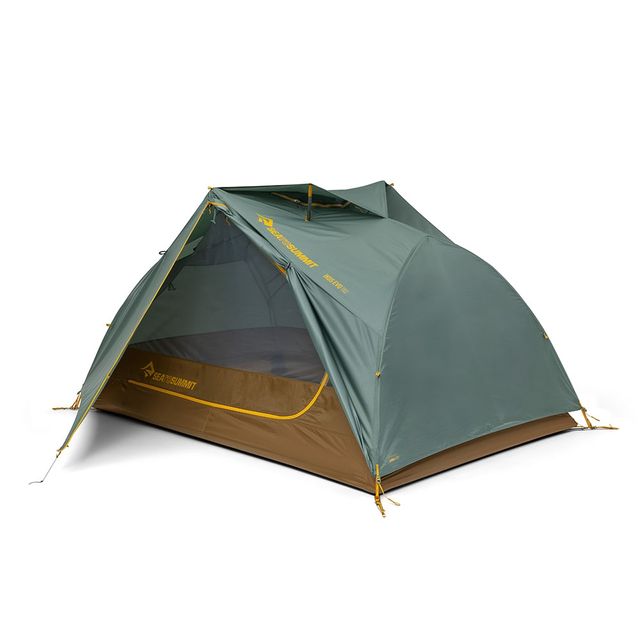
The Ikos brings the design thinking behind Sea to Summit’s premium tents into a tougher, more comfort-focused package. Its Tension Ridge pole design lifts the walls almost vertical, which creates headroom you’d normally only find in much bigger tents. There’s space to sit up side by side, get changed, and move around.
Heavier-duty 68D fabrics and a strong DAC pole system mean it’s built for frequent use and rougher conditions. You can pitch it in several configurations, including inner-first, fly-only, inner-only, and partial fly, to suit the weather on the night. A large ceiling vent prioritises ventilation and internal storage is abundant.
Key specs (TR2): 2.514 Kg | 1800mm waterhead fly | 4000mm waterhead floor| freestanding | bluesign APPROVED fabrics | DAC MX 9.6mm alloy poles
Also available 3P and 4P versions
Worth knowing: The Ikos prioritises durability and space over weight, so it’s not the choice for serious gram-counting ultralighters, while the TR4 is the perfect compact car camping tent.
Best for: Hikers who want premium build quality and a roomy interior, whether they’re backpacking or car camping.
One tent for any adventure – Sea to Summit Sentinel
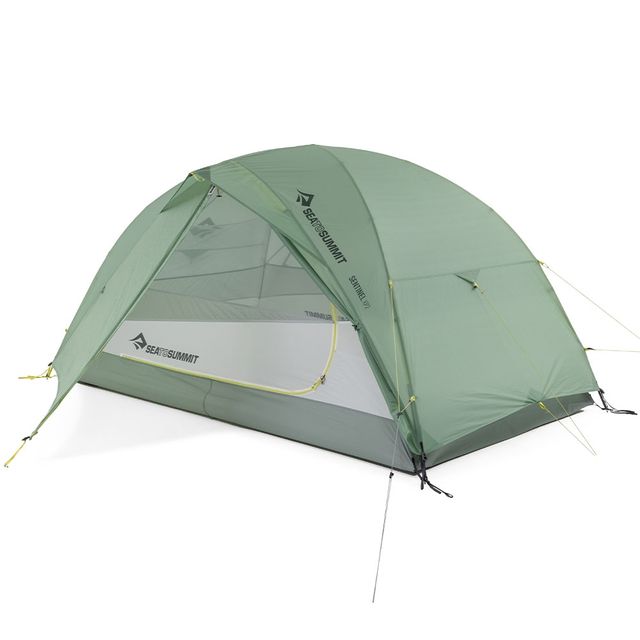
When the forecast turns ugly, the Sentinel is the tent you want to be in. An aerodynamic hub pole design, combined with self-equalising guy lines, keeps it stable in winds above 80km/h. The floor carries a remarkable 25,000mm waterproof rating, so saturated ground and standing water aren’t a worry.
Fly-first pitching and dry pack-down keep the inner protected when you’re setting up or breaking camp in the rain, and cross-flow vents help manage condensation on long, wet nights. It’s freestanding and offers four pitch modes, from standard setup to open stargazing. Steep walls keep things liveable when you’re stuck inside waiting out the weather.
Key specs (XP2): 2.12 kg | freestanding | 2000mm waterhead fly | 25,000mm waterhead floor | 2 doors, 2 vestibules | DAC alloy poles | Multiple setup configurations | bluesign APPPROVED fabrics
Also available in 1P version
Worth knowing: It’s built for hostile weather, so on fair-weather trips you’re carrying more capability than you need.
Best for: Hikers who want one tent that can handle everything, from summer overnighters to alpine storms.
The institutional classic – MSR Hubba Hubba LT 2
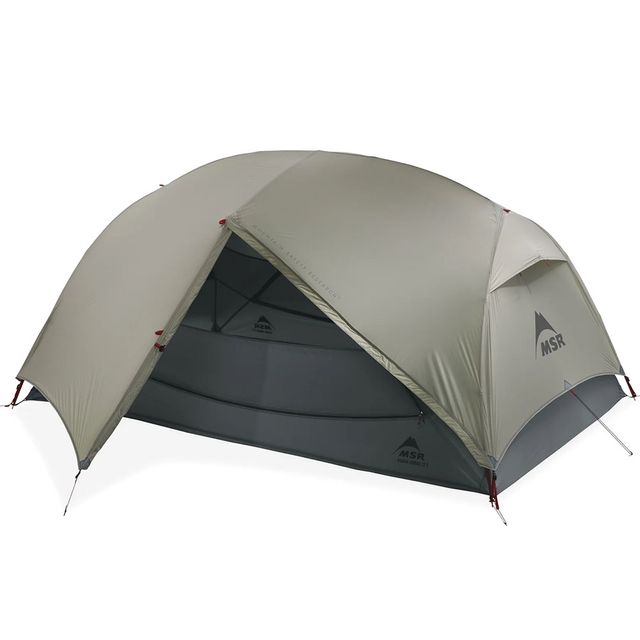
There’s a reason you see Hubbas pitched at campsites from the Larapinta to Tasmania’s Western Arthurs. It’s one of the most trusted backpacking tents ever made. A rectangular floor plan and generous headroom make the most of every centimetre. Two large side-entry vestibules give each hiker their own gear storage, and rain gutters on the doors stop drips from getting inside.
A unified hub-and-pole system with a symmetrical design makes pitching fast, and composite Easton Syclone poles are designed to resist breaking in rough conditions. It’s a light, liveable, well-proven tent that has earned its reputation the hard way.
Key specs : 1.54 Kg | 1200mm waterhead floor fly | 1800mm waterhead floor | freestanding | 20D ripstop nylon fly | DAC NFL 9.3mm poles
Worth knowing: Ultralight 20D fabrics call for a bit of care, and a footprint is a smart addition.
Best for: Committed backpackers who want a proven, lightweight tent for multi-day trips.
Heavier, easier on the budget – MSR Elixir 2
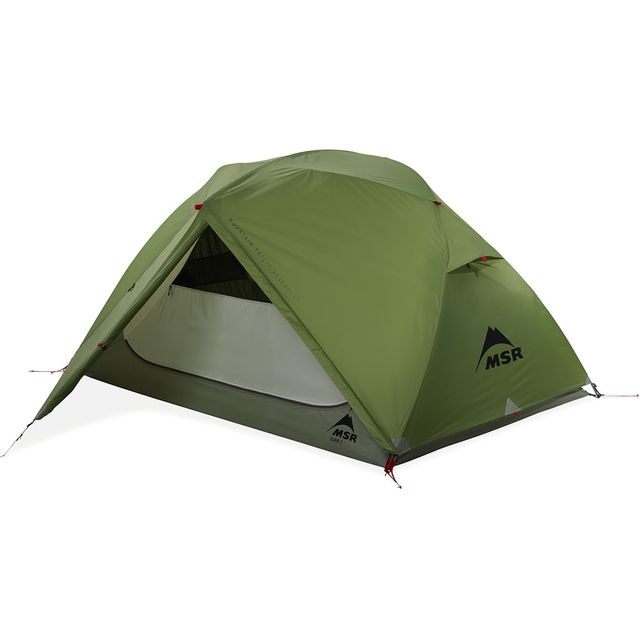
If you want MSR pedigree but aren’t counting every gram, the Elixir is well worth a look. It comes with a footprint included, which opens up a lightweight pitch using just the fly and footprint. Two large doors and vestibules sit alongside a genuinely roomy interior for two. It uses thicker fabrics than the Hubba series, and it’s built for durability.
Pitching is quick and intuitive, thanks to a freestanding design with colour-coded poles, clips, and webbing. The unique pole geometry opens up generous headroom, so there’s space to sit up, get changed, and sort your gear. A mix of breathable mesh and solid inner panels balances airflow, warmth, and privacy. Built-in gear lofts and glow-in-the-dark zip pulls keep essentials within easy reach after dark.
Key specs: 2.82 Kg | 1500mm waterhead floor | 3000mm waterhead fly | freestanding | 7000 series aluminium poles | footprint included
Also available in 3P version
Best for: Hikers who want MSR quality with extra toughness and are happy to carry a little more.
Shelter alternatives: going minimal
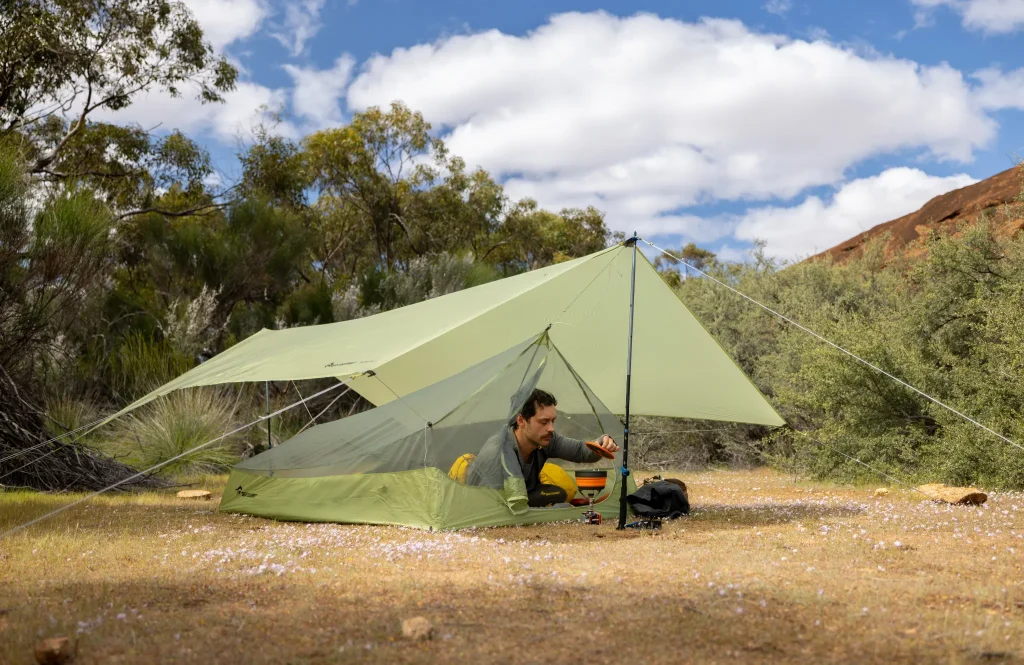
Not every trip calls for a full tent. Tarps and flies are the go-to for ultralight hikers, fast-packers, and hammock campers. They’re also popular with anyone who likes a more open connection to the bush. They’re light, flexible, and endlessly configurable. Pair one with a bivvy bag, bug net, or groundsheet, and you have a complete shelter at a fraction of the weight of a tent.
The trade-off is protection. Tarps are more exposed to wind, rain, and insects, and they take more skill to pitch well. They reward a bit of practice.
OZtrail Hiker Fly

Simple, tough, and endlessly versatile, the Hiker Fly is a great entry point into tarp camping. UV-resistant fabric and a curved catenary cut keep the pitch tight and free of flapping, and eyelets and webbing loops give you plenty of pitching options. Use it as a standalone shelter, a camp kitchen cover, or extra weather protection over your tent or swag.
String it between trees, use your hiking poles, carry extra poles or improvise with nature, there are many ways to setup a tarp like this. It can also act as a second layer of shade when pitched over another tent, reducing the temperature inside significantly.
Key specs: 350 x 210cm, 800g | factory-sealed seams | central hanging loop | 8 guy ropes and 6 pegs included (poles sold separately)
Best for: First-time tarp campers and anyone who wants a versatile fly for hiking and car camping.
Sea to Summit Minimalist Tarp
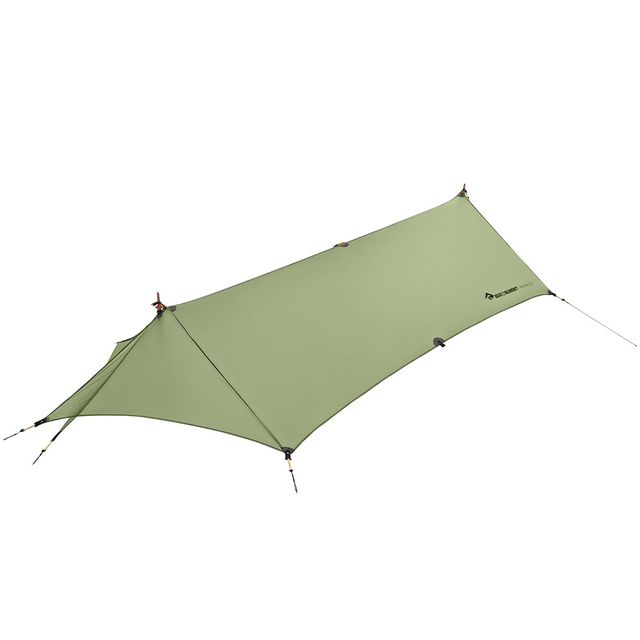
Twin storm flaps can close off wind and rain or fold open for extra shade, and a catenary cut keeps the pitch taut in strong wind. Ultra-Sil LS fabric absorbs less water and stretches less than standard silnylon, so it stays tight when wet. It’s also compatible with Sea to Summit’s Escapist mesh bug shelter for buggy conditions.
Use your hiking poles for setup, or improvise with whatever is available, this is the perfect ultralight shelter for adventures in mild conditions, it will keep you dry in light showers, protect you from overnight dew, and provide shade when it’s needed.
Key specs: 403g | approx. 337 x 201cm | Ultra-Sil LS 15D nylon/30D polyester ripstop | 18 x 9 x 9cm packed
Best for: Solo ultralight hikers, since its width suits one person.
Sea to Summit Escapist Evo Tarp
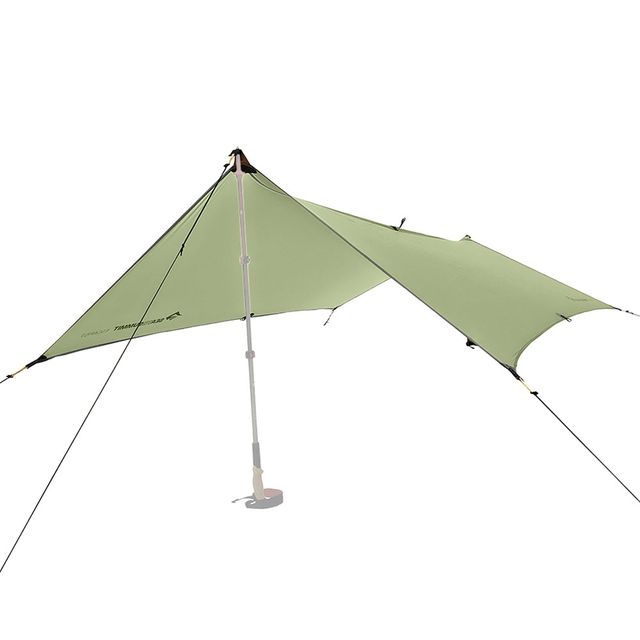
Made from 15D Ultra-Sil Nano fabric, the Escapist has eight reinforced tie-out points that each take the tip of a trekking pole. That opens up a huge range of pitch options. Pitched as an A-frame, it can shelter two sleepers, and it doubles as a tent awning or sun shelter.
Pitched with anything that can double as a pole such as walking poles, paddles, or sticks, the Escapist tarp is available in two sizes to suit 2-3 people and can be used with the optional Escapist inner bug tent to turn it into a full minimalist shelter.
Key specs: Medium 2 x 2.6m, 360g | Large 2.9 x 3.2m, 519g | 15D Ultra-Sil Nano | 8 tie-out points
Best for: Minimalist hikers who want one light, flexible tarp for solo or two-person trips.
Round out your setup
A great tent is only part of a good night’s sleep on the trail. A footprint protects your tent floor and extends its life. Quality pegs and guy lines make a real difference in wind. A sleeping mat suited to the conditions keeps the cold ground from stealing your warmth. If you’re pitching a tarp, trekking poles double as shelter poles and save you carrying extra weight.
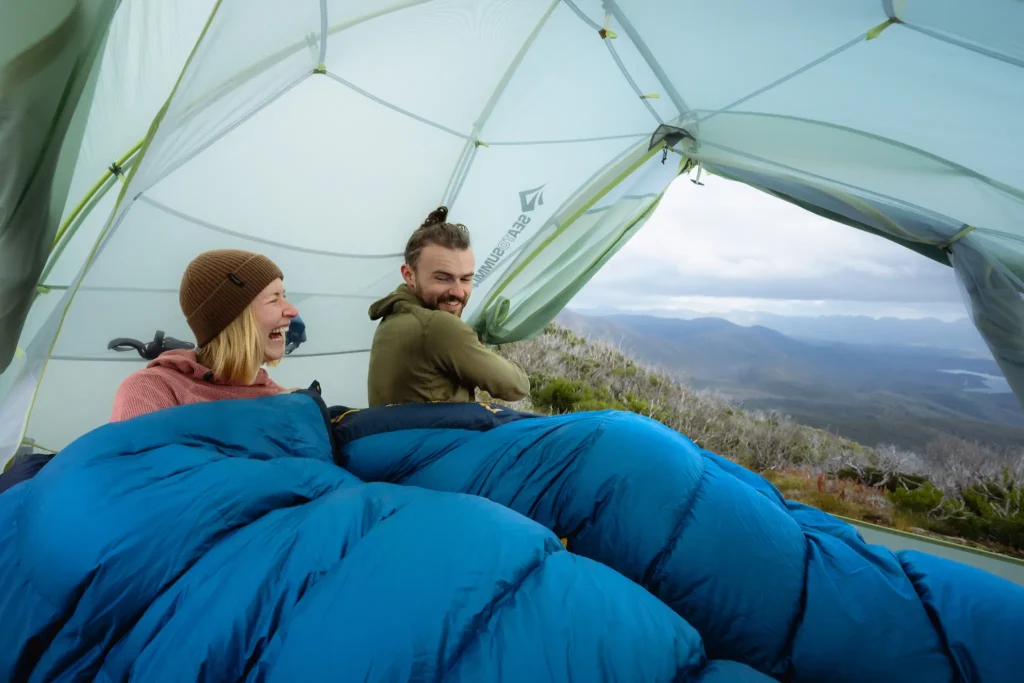
The best hiking tent is the one that gets you out there. Whether that’s a first overnighter on a local trail or a week in the high country, pick the shelter that suits the way you hike, and the rest will take care of itself.
Still not sure which way to go? Browse our full range of hiking tents, or drop into store or get in touch with our team for friendly, experienced advice.
Hiking Tent FAQ’s
For most 2-person hiking tents, around 2-2.5kg is a comfortable target. Ultralight options dip below 1.5kg, while tougher or roomier tents can reach 3kg. The right weight depends on your budget, how far you’re walking and/or how much comfort you want at camp.
For most hiking, no. A good 3-season tent covers the vast majority of Australian conditions. If you’re heading into alpine areas in winter, exposed high country, or Tasmania’s highlands, a storm-rated or 4-season tent is worth considering. A tent with an extra sturdy frame and vertical walls will be required for heavy snow regions.
It comes down to weight vs comfort. A 1-person tent is lighter and packs smaller, while a 2-person tent gives you room for your gear inside and space to move on a wet day. Many solo hikers find the extra space worth the extra few hundred grams. That being said, modern pole configurations open up a lot of head space in a 1P tent making them feel roomier than you may think.
It’s not essential, but it’s a smart investment. A footprint protects your tent floor from abrasion and punctures, which extends its life, especially with lightweight fabrics. Some tents also use the footprint for a lighter fly-only pitch, and the footprint doubles as a lunch mat if you need somewhere dry to sit during the day.
Absolutely. Hiking tents are great for car camping, especially when space in the car is tight. Just expect less headroom and living space than a dedicated car camping tent. The Sea To Summit Ikos Evo TR4 is a great example of a hiking style tent for car camping.
Ventilation is key. Open the fly vents, keep the doors partly open where you can, and try to pitch away from low-lying damp ground and water. Keep wet gear in the vestibule rather than inside, and make sure your fly is pitched taut so it doesn’t touch the inner. Read this article for more information>>.
Always dry your tent fully before storing it, even if it means pitching it in the backyard when you get home. Store it loosely in a cool, dry place rather than tightly compressed, and clean off dirt and sand to protect zips and fabrics. Tune into Episode 12 of the Snowys Camping show for more information on caring for your gear.


Trekker, swimmer, surfer, climber, mountain biker, runner, camper.
Participator in most things… master of none.
Also a co-host on the Snowys Camping Show podcast and Snowys team member for a very long time.
No mention of either the
mont Moondance 1p,2p or ex (3p) or the or the Moondance fn (full nylon)
Or
Mont dragonfly
I would have thought this Aussie brand would have made it on the list
Mont tents are awesome, no arguments from me there, they just aren’t products we sell.
Hi Guys, We purchased a Spartan 2 a couple of years back and it’s been great! We’ve done a few multi day hikes and it has stood up to heavy downpours, overall no problems with it. It is on the heavier side being over 2kg, but it’s sturdy and you don’t need the added weight of a footprint. In warmer weather you can ditch the fly and use a lighter tarp overhead or go without. This tent is free-standing too, which makes it very versatile. Now that we know that hiking is our thing, would look at something in the ultralight dept to drop some weight in the packs, but it does seem like a substantial price jump to get anything durable in the ultralight. The Spartans are a great introduction tent for hiking, or a minimal fuss – throw in the car for a weekend overnighter somewhere.
Weight is a critical factor in determining what is is a good or bad hiking tent, but there’s no mention of this in the reviews.
Hi David, thanks for your message – and great point. These blogs tend to highlight the main features of each product (e.g. lightweight design, sturdy frame, etc.), then link to their respective product pages where the more detailed specs are displayed (like weight etc.).
I’m surprised Mont didn’t make it to the most popular….
Hi Leonie, thanks for your insight! These ‘Best’ blogs only reference the brands that we sell at Snowys. Mont aren’t a brand we stock 🙂
Soooo this article titled “the best hiking tents – 2022 review” is not really an article about the “BEST” hiking tents is it? It’s more along the lines of an article displaying your sales figures. And yes I did read the intro and I am aware you guys mentioned this. Don’t get me wrong I understand why it’s good to post this information but maybe something like “consumers choice – most popular hiking tents” etc would be a more relevant title for THIS article. Anyway that’s just my personal opinion…
Hey Mike, thanks so much for your message. This is a great point, and we have certainly considered other titles for this reason. We truly value our reader’s experience, so will take it on board 🙂
Ironically their number 1 tent is also their cheapest $99? So I would likely say that rather than upsell the better msr ECT, a seasoned hiker would already know that they have a passion for the trail. It’s not for everyone,. If you understood the words. Eg, the article is not a hikers blog, but clearly states what it is. I myself find your depth of perception lacking and as a personally as a retired hiker ((blown ligament RKn) car based 4wd hiking tent now)) wonder why you are so obviously so personally offended by a company’s blog on how they rate the number 10 tents. COFFEE? And you like what brand of coffee? White, back or sweet??? Your own personal style of hiking is one you will understand, WHEN you get off the keyboard and give it a go. Me, I am a romantic hiker who will hike in somewhere breathtakingly visually and audio incredible. Then using a day pack hike back out to get more food and water supplies and return to my hiking spot. Some are trailblazers and want to complete the course in a time specific zone. Adrenaline rush and endorphins plus. Do you actually hike ? If not he author has stated he sells no 1 the $100 hiking tent and you can decide if you like hiking. Any experienced hiker not being a trailblazer will all want number 10. If you love hiking you will come back and continue to upgrade your equipment and I kid you not, a top quality hiking tent usually sells for $600 -$1200. Most of us stick to the $350-$450 mark. Spoiling ourselves as we will continue hiking and breaking out our kit just to clean and maintain. So any hikers blog is also like their personal choice of coffee or tea and whether white, black or sweet ECT. Happy hiking. Mike in Australia
Hi. Can you recommend a tent that would be good for newbie bikepackers? The tent would have to fit 2 adults plus gear most of the time but would also occasionally be used for one person plus gear. Thanks
G’day Carol, sorry for such a delayed reply! There are lots of factors that will influence your decision – budget and frequency of use being the biggest ones. The Snowys crew are usually in favour of ‘buying once. buying right’ but since you’re a bikepacking newbie, I’d suggest balancing your purchase with your enthusiasm. I.e. not outlaying a huge amount of cash straight up just in case you discover after a couple of trips, that it’s not really your thing.
With that in mind, you could go an entry-level hiking tent like Coleman’s Ridgeline which is one of our top-sellers and a pretty great tent for its price. We’ve received positive feedback from our customers too but I’d recommend the 3P over the 2P as the vestibule area isn’t huge and you may need the extra space for storage, especially when travelling with 2.
https://www.snowys.com.au/ridgeline-3p-hiking-tent
If you’re super keen on doing regular trips and you’ve got the budget, a mid-range hiking tent will present better value in the long run without you handing over a huge amount of cash for a top-dollar tent.
If going mid-range, I reckon it’s a toss-up between 3 and some of our Snowys crew are using these themselves…
Marmot Tungsten 2P – great vestibule room for your gear and dual entry.
https://www.snowys.com.au/tungsten-2p-hiking-tent
Black Wolf Grasshopper 2P or 3P – depending on how much gear you want to keep sheltered and how the regularity of solo trips vs 2 of you.
https://www.snowys.com.au/grasshopper-ul2-hiking-tent
https://www.snowys.com.au/grasshopper-ul3-hiking-tent
and
Zempire Zeus – quality materials plus a good amount of space for 2 of you plus gear.
https://www.snowys.com.au/zeus-hiking-tent
You might find it useful to read our customer reviews on each of those product pages as nothing beats gaining insight from people’s personal experiences. Plus, don’t hesitate to get in touch with our Customer Support team – they’re awesome and always happy to help out. Cheers mate
service@snowys.com.au
1300 914 007
I would like to comment on the Marmot tent mentioned above. My brother and I both bought this tent and have used them a number of times on our semi regular sea kayaking expeditions. I like the design and the quality of the fabrik very much and have found it a very good ten sandy (with sand pegs) and poor camping environments which are common when sea kayaking. The poles are not of the same high quality, I have split the join in the spar that keeps the fly off the tent body, when I repaired the split it then split further down the spar on the next expedition. My brother has had the mainframe split at the join in a few places. When I reported this to the outlet they said that they had not had any complaints about this model and suggested I might be lying. My brother found a website where purchasers of this tent shared advice on how best to repair the frame joins that are prone to splitting, so much for this being a rare issue. He also posted on the Marmot site saying how much he liked the design of the tent but the frame joint weakness was an issue and his comment was deleted, no wonder you don’t hear about these issues. Would still like the tent if I could get a reliable (non-split joins) frame but am less impressed with the outlet and the company.
It sounds like your Tungsten tent hasn’t performed up to standard and that you haven’t been able to get a good response from the brand, so I’m sorry to hear about that Geoff.
As far as I can find, we haven’t had any other uses report the same issue with splitting, but that’s not to say that it doesn’t happen, it’s just something we weren’t aware of until now.
If you do have a problem with a tent you buy from us in future – just touch base with our customer support team and they will get it sorted on your behalf. Thanks for your two cents, Geoff! Cheers.
My Macpac Eclipse has been a gem, and more recently the Mannagum Howqua 2 has proved to be ideal for my motorcycle and kayak excursions …
I bought a tent a couple of years back that seems to have gone under the Radar. The Mannagum Delatite 1 is a little beauty. You can still pick them up but they seem to be rare. Around AU $150 – 200. I don’t know if you can get a footprint for them but if you could it would be fantastic. Light and easy to put up it is my favorite hiking tent.
Thanks Snowys. I’ve been trying to decide between a few of these tents for a while now. It’s nice to see them all in one place.
Thanks Snowys. I’ve been trying to decide between a few of these tents for a while now. It’s nice to see them all in one place.
I’ve got the atom and love it. I’d like something similar but freestanding for a cycling tour. Anything you’d recommend?
We’ve got a few options for you that are 1P freestanding tents depending on how much you want to spend starting with the Marmot Tungsten 1P tent which also comes in an ultralight, the Freelite 1 and the Hubba NX – I hope that gives you a few models to start your research Brad!
Vango 2 person tent… bought from the UK as I thought a 3 season UK tent would be equivalent to a 4 season in in Australia. Only issue is is def not lightweight. But stands up to the harsh conditions.
Absolutely Peter, our purchasing team brought the Vango tents into our range for that very reason! They’re ideal for winter use in Australia, but aren’t the lightest tents by any means.
Great ideas…what would you recommend in term 4p hiking tents…trying to keep as light as possible as carrying gear for x2 kids
We don’t have any 4P hiking tents in our range at the moment as they’re not a big seller for us, unfortunately. In the past, we have had the Papa Hubba from MSR which is a high quality 4P lightweight tent – so that might be a starting point for you Josie.
Even though I’m not in the market, I am a gear junkie so this tickled my interest, not showing weight though is a big miss for me.
If your milti-day/week hiking, weight is an important consideration.
My 1st 1P tent was 1.7kg (heavy). My latest a Big Agnes 2P (needs trekking poles) is 880g, this is still heavy for me and is used only when ground camping is a must.
Otherwise I use a ultra light Hammock/Tarp system.
I’m sure other gear junkies would definitely agree with your position, Matthew. However, we’ve put together this list from our sales data, and I suppose there are just a lot of beginner hikers out there who weren’t ready to splurge on ultralight tents this year!
Yep, totally agree , ultralight article with no weights mentioned at all. Very poor effort. Probably reflecting that none of these tents are ultralight. It’s very hard to find anything decent in Australia. Up your game and start offering some real ultralight tents snowys.
Great to have your input, Kent. As Emily explained in her response to Matthew, we use our sales figures to determine what is in most demand and this collection represents our best sellers from the past 12-months. We do have a new range of German expedition hiking tents coming so perhaps we’ll see those represented in next year’s list. Cheers
Don’t agree with many of these at all.
Some could be hiking tents if you split them up between two people but even then, there are tents that are way lighter (albeit more expensive).
That’s definitely an option Tim, but our top 10 is based on sales volume which probably why all the more affordable (but clearly heavier) models are so high on the list.
the main thing I was looking for in this article was ‘weight’. To be honest, no-one mildy serious about pack hiking would look at a tent over 1.7kg these days. Many wont go over 1.5kg.
Totally agree with Pro Hiker tent being number 1..we have Pro hiker 3 and used for car camping under a tarp ..so roomy inside and plenty of head space plus the extra short pole that keeps the two vestibule fly sheet from sagging.
No other hiking tents than Hilleberg for me. Quality, best weight to space ratio and last decades.
Soulo. That thing is a four season free standing bomb shelter, and worth the weight for cold weather camping or pagoda exploring where actual soil is minimal or non existent.
Critical to me are weight, packing size and price. I would like to see a summary table of these items.
That’s a fantastic idea Melvyn, the only thing is that it’s tricky to keep the info up to date but we will definitely keep this feedback in mind for next year, so watch this space. By the way, you can always just jump on our website and use the compare function in the meantime to see all the specs side by side if that helps – cheers!
Hi there,
Thanks for this post. I’m looking for a 3p hiking tent but it needs to be as light weight as possible, as I’ll be carrying it with other gear for taking kids overnight hiking, and I have knee issues. Can you advise what would be the lightest weight 3p tent you have at a reasonable price for someone who won’t be using it more than a few times a year? Thank you
No worries, we’re glad you liked the post Pden! In terms of our lightest 3P tents that are still high quality with enough interior space for kids, the EPE Spartan 3 is a good choice at 3.3 Kg. If you’re willing to spend a bit more money, then a step up in quality that’s lighter at 2.985 Kg is the Limelight 3P tent from Marmot. I hope that gives you a couple of options to work with, Pden – happy hiking!
What parts of the spartan 3 are mesh, and are any of them closable?
I’ve just double checked this for your with our display model Geoff, and the Spartan 3 tent has a solid inner, with mesh doors that can’t be closed off.
It seems the MSR isn’t available on the site! Will you be getting anymore in?
We have run out of the older model MSR Hubba tent as they’re not making them anymore, but I’ve just double checked this with our purchasing team, and we’re hoping to get the 2019 Hubba tents in mid-march, Christina.
I thought I asked this question previously but cant find a reply.
Why did you rate the Companion Pro Hiker above the EPE Spartan 2?
When I look at the price and the specifications the Spartan 2 seems to have advantages.
Lower in price by $10.00
Better water rating on both floor and fly.
The only advantage I see for the Companion Pro Hiker 2 is it is slightly wider.
I intend doing the Great Ocean Walk 100k after Christmas and need a tent so would appreciate a prompt reply.
Regards
Doug
Hi Doug, these are ordered purely based on sales i.e. we sell more Pro Hiker 2 tents, both of these tents are excellent value for money though. The Spartan 2 is a lesser-known tent which is likely why it has had fewer sales, or possibly because it offers less floor space, but I think that as time goes on we will see the Spartan 2 become a close competitor to the Pro Hiker 2. Personally, I prefer the Spartan 2 as the pole configuration facilitates upright walls and increased internal volume, the vents are also larger for better ventilation and it’s a touch lighter. That’s just my two cents worth though. Enjoy your walk.
How about a review of which tents are actually better? I don’t care that you sell more of a cheap tent because it’s cheap.
Which tents are better is very subjective, Chris. Better for what/who/where and for what price?
We don’t want to be biased towards any particular model and the best feedback we can get on any tent is from those who are using them regularly i.e. our customers. This has meant that some cheap tents have surfaced as particularly reliable and affordable models for their price. Any tent, whether they be cheap or expensive, that become a regular appearance on our warranty shelf quickly disappear from our range.
Give us a call if you’d like some help choosing a tent that is best for you.