There are clear benefits to using a stretcher in your tent. It not only gets you up off the ground (something older campers appreciate) but also frees up storage space. Two king-sized mattresses in a 3-4-person tent leave little room for your gear, but put a couple of stretchers in there and you still have space underneath.
The only sticking point is that a stretcher and mattress of the same length and width won’t necessarily fit into the same tent.
Stretcher height (45cm in my test) combined with a sloping tent wall meant that, in some of our display measurements, the usable space for a stretcher shrank by up to 45cm. In a few cases that took a tent from five people on mats down to just two on stretchers.
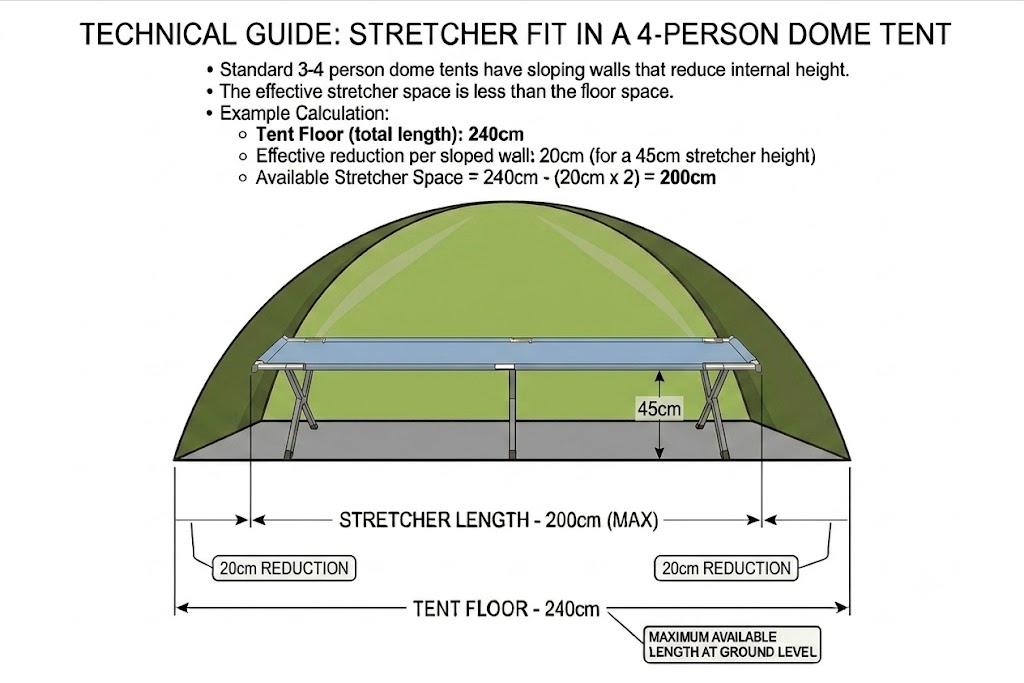
The formula (for a 45cm-high stretcher):
Tent Floor Length – Reduction Per Sloped Wall = Available Stretcher Length
How To Find a Functional Stretcher & Tent Combination
One size doesn’t fit all here. In my calculations I’ve considered common tent styles and worked out a number to guide how well a given stretcher will fit inside a tent. Make sure you also factor in head height. For the most part you should still be able to sit up, but some smaller domes may not have the headroom to make the setup comfortable.
Keep in mind that if your stretcher is also positioned along a tent wall, you’ll lose space at each end and along the side against the wall, assuming that wall is sloped too. If the walls slope sharply, this can eat into your sleeping space, because your sleeping gear adds to the total stretcher height. In some cases the inner tent wall may end up very close to your face.
Use the guides below to calculate stretcher suitability for popular tent styles.
Boxy Touring & Cabin-Style Tents
Reduce usable length for each sloped wall by 15cm
A cabin-style tent has a boxier shape than other styles, with flat, relatively upright walls. These tents include the popular Coleman Instant Up and OZtrail Fast Frame series, along with the square and cabin versions of the BlackWolf Turbo tents.
This measurement only applies to the single-room versions of these tents. The models with an extended sleeping area or multiple rooms are listed below.
3-4 Person Dome Tents
Reduce usable length for each sloped wall by 20cm
The walls of a traditional 3-4-person dome tent tend to slope more than cabin-style tents, so adding a stretcher removes roughly 20cm from either end. This further confirms there’s no blanket formula to cover the various shapes and structures across all tents. With 40cm lost in total, these tents leave room for perhaps one stretcher.
Manufacturers these days are designing dome tents with more upright walls to create extra internal space.
Family Camping & Touring Tent Sleeping Areas
Reduce usable length for the end sloped walls by 25-30cm
Family dome tents such as the Coleman Instant Up Northstar, BlackWolf Turbo Twin models, and OZtrail Fast Frame BlockOut Lumos 10P are built around a central room with a sleeping area at each end, where the outer wall slopes sharply. Because that slope is so pronounced, the end rooms need extra reduction: adding a stretcher can cost up to 30cm.
If you put a stretcher on each side, one end sits flush against the inner wall, but the 30cm lost at the sloped end shrinks a room measuring 220cm at floor level to around 190cm at stretcher level, which won’t fit most stretchers (the majority run 195-205cm). In these tighter spaces, a 25cm-high stretcher or a sleeping mat is the better bet.
Oztent RV & RX Tents
Reduce usable length for each sloped wall by 35cm
Oztents have a unique structure: the rear wall slopes significantly while the other three stay upright. That slope reduces the usable space by 35cm for a 45cm-high stretcher.
These are single-skin tents, so you want to avoid touching the inner walls as much as possible, especially in cold weather. If your stretcher is too tight, it can create a rub point that, over time, wears away at the tent’s inner.
Most Oztents will fit one stretcher comfortably, while the Oztent RV-5 will fit two at a squeeze. Even so, stretchers are a good option for campers with mobility issues, and for them a shorter or lower stretcher works best.
Tents With An Extended Sleeping Area
Reduce usable length for each sloped wall by 45cm
This category covers the boxy cabin-style tents from earlier, but with an extended sleeping area or extra room that usually has one wall sloping more than the rest. The BlackWolf Turbo Plus is a good example: a box-shaped front room with a steeply sloped section at the back. The rear slope is the only place you lose this much space. The remaining walls can be calculated as outlined above.
This measurement also works as a guide for similarly shaped sleeping additions, such as the OZtrail Gazebo Portico tents, which have three upright sides and a sloped rear wall. The Darche Safari 260 and 350 are an exception: all their walls slope significantly, so apply the 45cm reduction to every wall, not just the rear.
Note: These measurements are only intended to be used as a guide. Each tent will have its own unique structure.

Summing It Up
For sleeping mats up to airbed height (around 15cm), a tent’s floor dimensions are a good enough guide, since a standard mat only reaches the top of the bucket floor. Stretchers need more thought: the tent’s design, the space you’ll lose, and how comfortable you want to be. Some point to the storage space a stretcher frees up underneath, but the space that really matters is around your head and feet, where a poor fit interferes with sleep.
Stretchers are a popular choice, and not just for campers with mobility issues. Even so, I lean towards the sleeping mat ranges from Exped, Zempire and OZtrail, which offer better comfort and insulation than most stretchers. A stretcher usually needs a sleeping bag or insulating layer to be much more comfortable than it is on its own, and its feet can damage tent floors. Still backing stretchers over mats? Convince me.
My verdict: a stretcher can certainly fit in a tent, but doing so means weighing up a real loss of space. Think about leg room, walking space, how easily you can climb in and out, and how freely you can move around inside. So… does that stretcher fit that tent?


Trekker, swimmer, surfer, climber, mountain biker, runner, camper.
Participator in most things… master of none.
Also a co-host on the Snowys Camping Show podcast and Snowys team member for a very long time.
how many stretchers culd yo fit in a 5m x 5m square army tent
Generally speaking, the average square army tent has fairly straight walls which allow more space for stretchers. How many depends on which stretcher you’re looking at and how much space you wish to have between each stretcher. Our advice would be to note the dimensions of your preferred stretcher(s) which are detailed on the product page, and then do a rough calculation based on the 5m x 5m (or 500cm x 500cm) allowance of your tent. Hope that helps you out, Marianne!
What about pop up tents
Most single camp stretchers that we have in our range are a little too long to fit inside a standard sized pop-up tent, which is why we haven’t included them in this article, Jared.
If you’ve got one yourself though, I’d recommend checking the floor plans on our website and comparing them to the stretcher you’re interested in to get an idea of fit.